How Much Will $500 a Month Grow to in 20 Years? (At 5%, 7%, and 10%)
$500 a month doesn’t feel like much. It’s a car payment, or a serious grocery bill. Sock it away every month for twenty years and it turns into something most people wouldn’t guess. The answer depends on the return you assume, so let’s look at three.
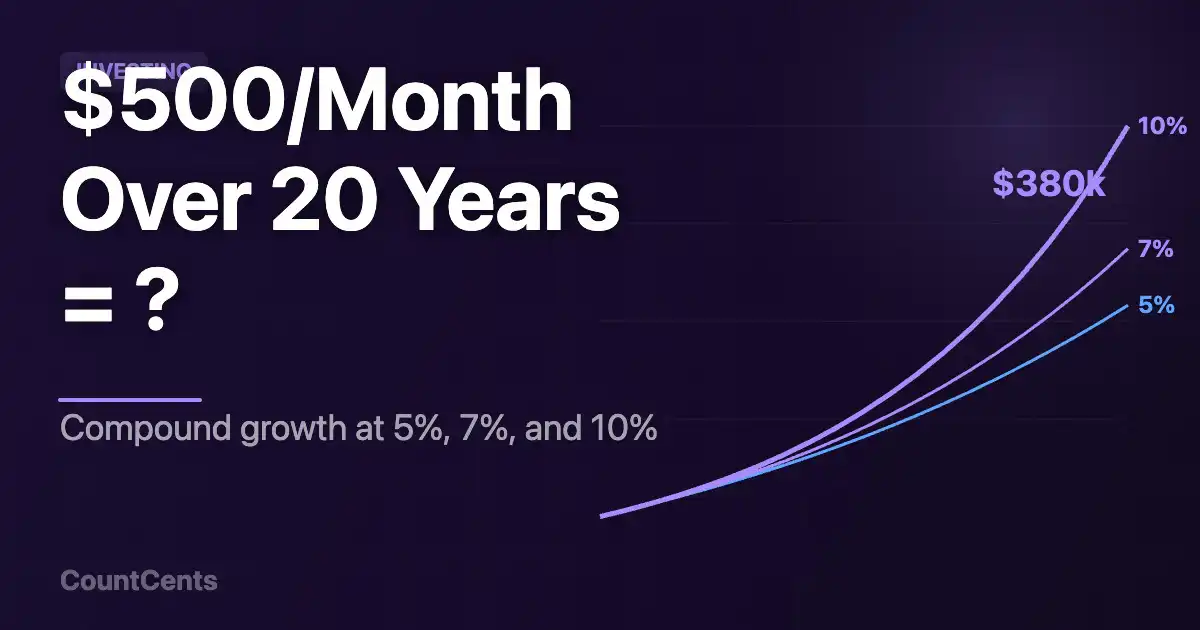
The numbers: $205,517, $260,463, or $379,684
Assume the $500 goes in at the end of each month, with returns compounded monthly:
- 5% annual return: $500 a month becomes $205,517
- 7% annual return: it becomes $260,463
- 10% annual return: it becomes $379,684
Here’s the part people miss: you only put in $120,000 ($500 × 240 months). At 7%, the other $140,463 is growth. More than half of the final balance is money your money earned. Compounding does the heavy lifting; your contributions just keep feeding it.
How the math actually works
Each month’s deposit starts earning immediately, and next month’s deposit joins a balance that already includes last month’s gains. The future value formula is: payment × [((1 + monthly rate)months − 1) / monthly rate]. At 7%, the monthly rate is 0.07/12, and over 240 months that factor turns $500 into $260,463. You don’t need to memorize it. The compound interest calculator does it for any monthly amount, rate, and timeline you like.
The real lesson: the first $500 matters more than the last
Run the same $500 a month at 7%, but start five years earlier, 25 years total. Final balance: $405,036. Now start five years late, investing for only 15 years: $158,481. That five-year hesitation costs you about $102,000, even though you put in $30,000 less.
Early deposits compound for the longest, so time is the biggest lever in the whole equation. This is the math behind Coast FIRE, the idea of front-loading investments so growth can do the rest: get a pot growing early and you can sometimes step off the treadmill sooner. Our FIRE calculator shows how many years of this it takes before work becomes optional.
Zoom in on the final five years and you see compounding at its loudest. At the 15-year mark, the account holds $158,481. Five years and $30,000 more in deposits later, it sits at $260,463, so the last five years added $71,982 of growth on $30,000 of new deposits, more than double the fresh money. The early years plant, the middle years water, the late years harvest. Even at the 10-year mark the snowball is visibly rolling: $86,542 against $60,000 contributed.
Half the money? Half the result.
The formula scales directly with the payment, which is a simple way of saying doubling your deposit doubles the outcome. At $250 a month, the same 7% over 20 years produces $130,232, exactly half the $500 result. Run it the other direction and you get the handy rule of thumb: every $100 a month you add is worth about $52,000 in twenty years at a 7% return. Skipping one $100 monthly expense and investing the money instead is, over two decades, quietly a $52,000 decision. If $500 isn’t in the budget, $250 still builds something serious.
Three reality checks
Returns are lumpy. The market doesn’t hand you 7% in neat annual slices. Some years are +20%, some are −15%. The average over decades is what these numbers describe, and the average hides a lot of stomach-churning along the way.
Inflation takes a bite. These are nominal dollars. If prices rise roughly 3% a year, a 7% return is more like 4% in today’s purchasing power. Still good, but $260,463 in 2045 dollars buys less than it buys now.
Debt comes first. If you’re carrying a card at 23%, paying that down is a guaranteed 23% return, and nothing in this article beats a guaranteed 23%. Kill the expensive debt first (see which payoff method wins on your balances), then let the $500 do its compounding thing.
The bottom line
Five hundred dollars a month for twenty years is $120,000 of your money and anywhere from $85,000 to $260,000 of growth, depending on returns. The wildest part isn’t any single number. It’s that the person who starts five years late needs to save for a decade extra to catch up. The math rewards the saver who starts slightly annoyed at 25 over the one who waits to feel fully ready at 35. If a transfer isn’t automated yet, automate it. Willpower is a terrible savings strategy, and a standing order never forgets.
Try your own numbers: pick a monthly amount and a return in the compound interest calculator and watch what time does to it.