Is Overtime Taxed at a Higher Rate? No. Here’s What’s Actually Happening
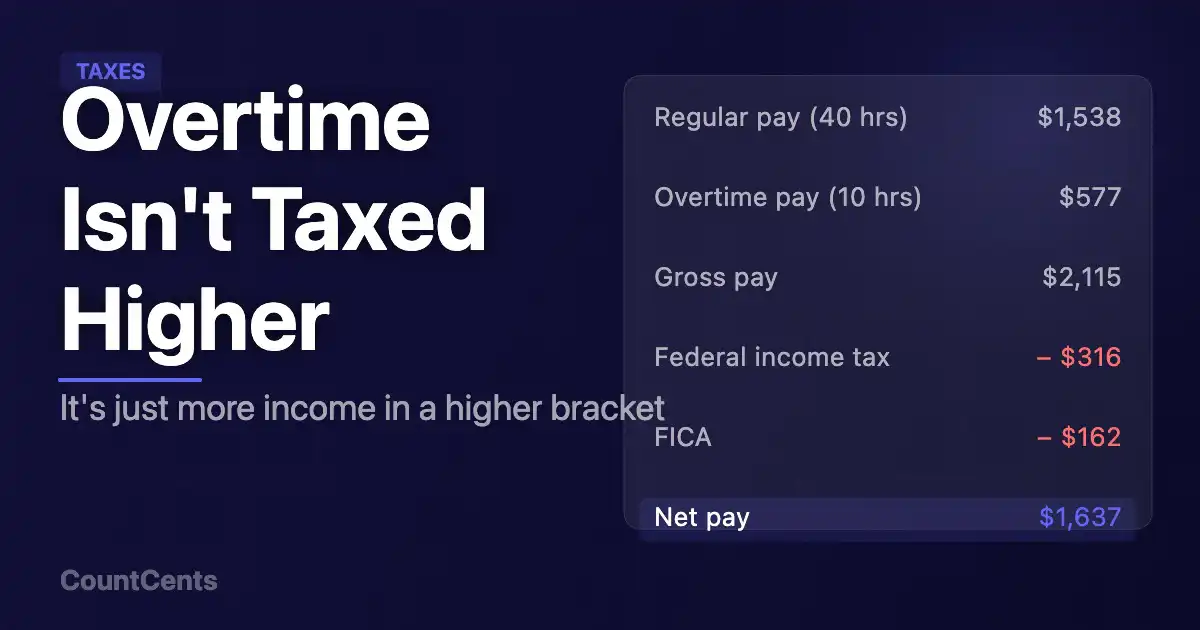
You worked ten extra hours last week. The gross on your pay stub looks great. Then you see the net, and it looks like the tax man helped himself to half the overtime. Somebody at work nods knowingly: “Yeah, overtime gets taxed at a higher rate. Barely worth it.”
It’s one of the most persistent money myths in any break room, and it’s wrong. Overtime is not taxed at a higher rate. Not by the IRS, not by your state, not by anyone. Something else is eating the difference, and it’s worth understanding because it changes whether those extra hours are a good deal (they usually are).
There is no overtime tax bracket
Federal income tax doesn’t care how your pay was earned. An hour of overtime wages lands in the exact same tax brackets as an hour of regular wages. There’s no separate overtime rate, no penalty box for crossing 40 hours, nothing in the tax code that even asks whether a dollar came from hour 39 or hour 41.
Your pay is your pay. The IRS sees one number: wages.
So why does the check look so bad? Withholding.
The villain is withholding, which is not the same thing as tax. Withholding is your employer’s estimate, sent in advance. Actual tax gets settled when you file your return.
Here’s the quirk. Payroll software looks at each check more or less on its own, multiplies it out as if you earned that amount every pay period all year, and withholds accordingly. Work a $20-an-hour job and pull a 50-hour week, and your gross for the week is $1,100 (40 × $20, plus 10 × $30 time-and-a-half). To the payroll system, that week looks like a $57,200-a-year pace, even if your real pace is $41,600. It withholds like you’re a $57,200 earner. Then a normal week comes along and it withholds like you’re not.
Over the year, it roughly balances out, and any excess comes back as your refund. The overtime wasn’t taxed more. It was prepaid more. If you want to see what an OT week should pay before any of this, run it through the overtime pay calculator.
Marginal brackets: the other half of the myth
The second misunderstanding sounds like this: “The overtime pushed me into a higher bracket, so all my income got taxed more.” That’s not how brackets work. They’re marginal, meaning a higher rate only touches the dollars above the line, never the ones below it.
For a single filer in 2025, the 12% bracket runs up to $48,475 of taxable income and the 22% bracket starts above that. Suppose overtime carries $1,000 of your income across that line. That $1,000 gets taxed at 22% instead of 12%, so $220 in federal tax. FICA (Social Security and Medicare) takes its usual 7.65%, another $76.50. You keep $703.50 of the $1,000. Every dollar you earned before the line is still taxed exactly as it was before you worked a single extra hour.
Keeping roughly 70 cents of an overtime dollar is a very different story from “the government took half.” If you want the full picture for your salary, the take-home pay calculator shows where a regular check actually goes.
The pay rules underneath it all
While we’re clearing up confusion: the right to time-and-a-half comes from the Fair Labor Standards Act, which requires most hourly (non-exempt) workers to get at least 1.5× their regular rate for hours past 40 in a workweek. Federal law only counts weekly hours. A few states go further. California, for instance, also requires overtime past 8 hours in a single day, and double time past 12. That’s a pay rule, though. It changes what you’re owed, not the rate at which you’re taxed.
This is also why comparing hourly offers gets confusing fast. If you’re weighing a job that leans on overtime against a straight salary, it helps to anchor on the base rate first: here’s what $25 an hour works out to per year, before OT enters the picture.
Should you ever skip overtime because of taxes?
Almost never. Even if every overtime dollar landed in your highest bracket, you’d still keep most of it. The example above kept $703.50 of a $1,000 crossing, and most overtime dollars land in the same bracket you were already in. There are real reasons to turn down a shift (fatigue, family time, a better-paying second gig). Taxes are not one of the good reasons.
One loose end worth knowing: if you work heavy overtime all year and get a fat refund every April, you’re handing the IRS an interest-free loan and collecting it back slowly. That refund is your own overpaid tax catching up, not a bonus. Some people prefer the forced savings. Just know which one you’re choosing.
The bottom line
Overtime is taxed like every other dollar you earn. A fat withholding bite on a big week is payroll math, not a tax penalty, and it settles up when you file. Turning down overtime purely because of the tax myth is turning down real money.
Curious what your next OT shift should actually pay? Plug your rate and hours into the overtime pay calculator and check the stub against it.